
How to Apply for Mining Learnerships in South Africa
How to Apply for Mining Learnerships in South Africa
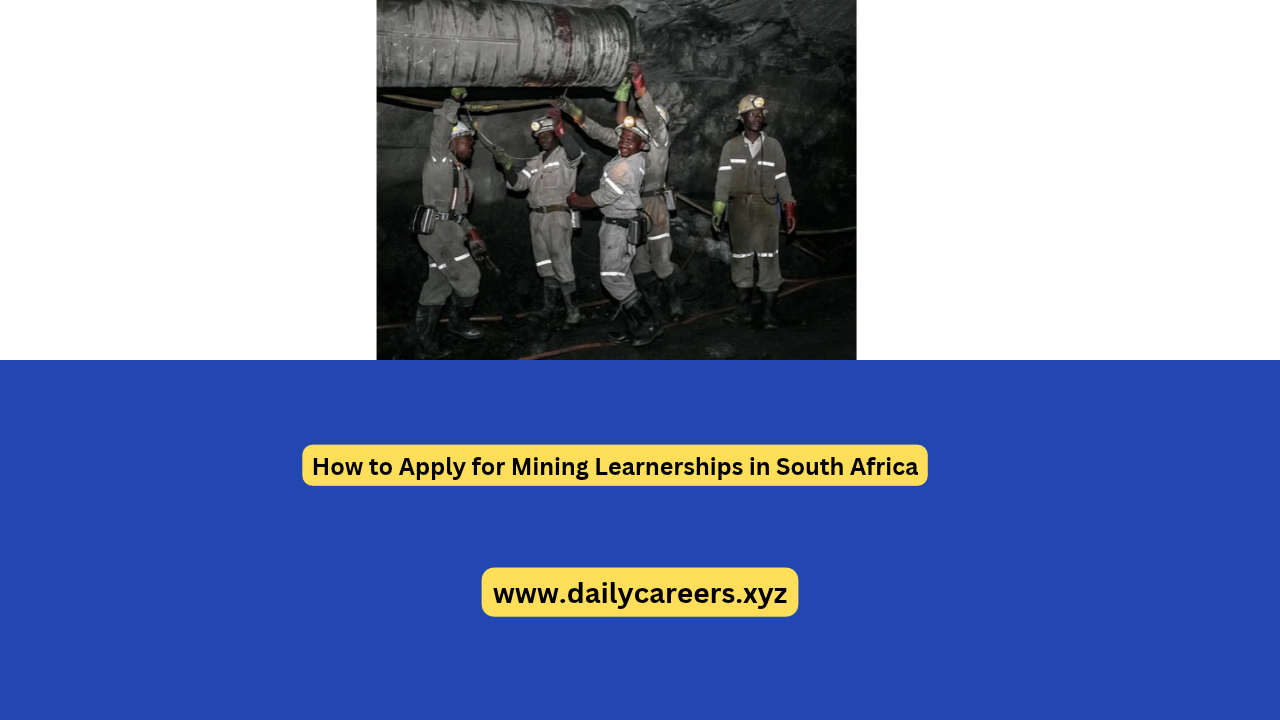
Mining learnerships can help you develop occupational skills through structured training and workplace experience. However, finding the right opportunity requires more than sending your CV to every mining company you recognise.
You need to identify an advertised programme, check its requirements, and apply through the correct recruitment channel.
This guide explains how to apply for mining learnerships in South Africa, including where to search, what documents to prepare, and how to avoid misleading advertisements.
This is an application guide, not an announcement of a particular open intake. Programme availability, requirements, and closing dates must be checked in the employer’s official advertisement.
What Is a Mining Learnership?
A learnership combines structured workplace learning with institutional training. The Mining Qualifications Authority, or MQA, describes an arrangement involving the learner, employer, and accredited training provider.
When reading an advertisement, check the exact qualification and training outcome. Do not assume that every opportunity described online as a “mining learnership” has the same structure.
An apprenticeship, internship, bursary, and learnership can serve different purposes. Use the employer’s official programme name when applying.
Do You Apply Through the MQA or a Mining Company?
The MQA plays a role in mining-sector skills development, but it is not a single application office for every mining learnership.
Its non-artisan learnership guidance tells unemployed applicants to approach mining companies for opportunities, explaining that the MQA facilitates and funds training for employers in the sector.
Start with the employer’s official advertisement. Do not assume that registering on a general database or submitting a bursary application also applies you for a learnership.
Where to Find Mining Learnerships
Use verified employer and training-information websites.
| Official source | What to look for |
|---|---|
| Sibanye-Stillwater South African careers | Recruitment links and advertised development opportunities |
| Implats careers | Career opportunities and recruitment guidance |
| Implats young talent | Information about graduate, internship, and learnership pathways |
| MQA learnership information | Background on mining-sector learnerships |
Sibanye-Stillwater identifies learnerships among its development opportunities. Implats states that its learnership opportunities are advertised through its careers channels with programme-specific application instructions. These sources do not mean an intake is always open.
For any other mining company, start at its official corporate website and follow the careers link.
Step 1: Choose the Type of Training You Want
Read beyond the word “learnership.”
Identify:
- The occupation or field.
- The qualification or learning outcome.
- The mine or operation hosting the programme.
- Whether the opportunity is for external applicants or existing employees.
- The training location.
- The expected duration.
This helps you avoid applying for an internal programme intended only for people already employed by the company.
It also helps you understand whether the work matches your interests. A technical maintenance pathway may involve different training and requirements from a processing or administrative opportunity.
Step 2: Check the Minimum Requirements
There is no single education or age requirement that applies to every mining learnership.
Use the advertisement to check the following:
| Requirement | What to establish |
|---|---|
| Education | The exact school grade or qualification required |
| Subjects | Whether specific Mathematics, Science, or technical subjects are compulsory |
| Results | Any minimum marks |
| Age | Whether the programme specifies an age range |
| Employment status | Whether applicants must be unemployed or already employed |
| Residence | Whether the programme targets a particular community |
| Experience | Whether previous experience is required |
| Other conditions | Any stated licence, assessment, or suitability requirements |
Do not assume that Mathematical Literacy satisfies a requirement for Mathematics. Similarly, do not assume that Grade 12 automatically replaces a specific technical qualification requested in the advert.
If the employer allows alternative qualifications, read the wording carefully.
Local Community Requirements
Some advertisements may prioritise or restrict applications to specified communities.
Check whether local residence is a compulsory condition or a preference. Do not change your address to appear eligible.
If proof of residence is requested, follow the stated requirements and provide accurate information.
Step 3: Prepare a Relevant CV
Your CV should make your education, location, and relevant abilities easy to identify.
Include:
- Your name and surname.
- Your cellphone number and email address.
- Your town and province.
- Your highest completed education.
- Relevant school subjects and results.
- Technical training, where applicable.
- Projects, employment, or practical experience.
- References where requested.
For a first-time applicant, school projects and genuine practical activities can help demonstrate your approach to learning.
Useful examples might show that you can:
- Follow written instructions.
- Complete calculations accurately.
- Work responsibly with others.
- Keep records.
- Solve practical problems.
- Ask for guidance when unsure.
Do not claim industrial machinery experience because you have watched a demonstration or online video.
Example Personal Profile
“Applicant based in [Location], with [accurate qualification] and an interest in [training field]. Developed teamwork and problem-solving skills through [genuine activity]. Seeking structured training to build practical workplace skills.”
Replace the placeholders and adapt the wording to the programme.
Step 4: Prepare Supporting Documents
Keep relevant documents available before the closing date.
These may include:
- Your CV.
- School results or qualification certificates.
- Technical qualification records.
- Identity documentation.
- Proof of residence, if required.
- Other documents listed in the advertisement.
This is a preparation list, not an instruction to send every document automatically.
Check whether copies need certification and at which stage. Do not assume every employer uses the same rules.
Use clear filenames, such as:
Name_Surname_CV.pdf
Name_Surname_Matric_Results.pdf
Open each file before uploading it. Make sure the text is readable and that every page belongs to you.
Step 5: Open the Official Recruitment Portal
Follow the application link from the employer’s official website or verified advertisement.
If registration is required, create your own candidate profile using contact details you can access.
Check:
- That the site is the destination linked by the employer.
- The privacy information.
- The required profile fields.
- Any account-verification instructions.
An external recruitment platform can be legitimate when the employer links to it. Verify the connection rather than judging by the platform name alone.
Keep your password and verification codes private.
Step 6: Apply for the Specific Programme
Select the advertised programme and complete its application.
Do not assume that creating a profile or uploading a CV applies you for every opportunity.
Enter accurate information about:
- Education and results.
- Location.
- Employment status.
- Experience.
- Availability.
- Any declarations requested.
Review automatically populated information if the system extracts details from your CV.
If the vacancy uses an application form or a verified email address instead of a portal, follow those instructions.
Step 7: Review Before Submitting
Use a final check to prevent avoidable mistakes.
Confirm that:
- You selected the correct programme and operation.
- You meet the compulsory requirements.
- Your contact information is accurate.
- Required fields are complete.
- Requested documents are attached.
- Files meet the format and size limits.
- You completed the final submission step.
Save any acknowledgement or application reference provided.
Submit early enough to address technical problems. A failed upload does not automatically extend the deadline.
Sample Email for a Mining Learnership Application
Use this only where a verified advertisement accepts email applications.
Subject: Application: [Learnership Title] — [Reference Number] — [Your Name]
Dear Recruitment Team,
I am applying for the [Learnership Title] at [Operation or Location], reference [Number].
I have completed [Qualification] and meet the advertised requirements relating to [relevant subjects or criteria]. My interest in this programme comes from [brief, genuine reason].
Please find attached my CV and the supporting documents requested in the advertisement.
Thank you for considering my application.
Kind regards,
[Full Name]
[Cellphone Number]
Do not send applications to a company’s general customer-service address unless the official advert specifically directs you there.
What Happens After Applying?
The employer’s advertisement or recruitment communication should explain the next steps.
Depending on the programme, applicants may be invited to an interview, assessment, or other specified screening process.
Do not assume that every mining company uses identical tests or selection stages.
Check your email, spam folder, and candidate account where status information is available. Keep your phone accessible.
An acknowledgement does not mean you have been shortlisted or appointed.
How to Prepare for Assessments
Follow the instructions sent by the verified recruitment team.
General preparation can include:
- Revising relevant school subjects.
- Practising basic calculations.
- Reading instructions carefully.
- Explaining how you solve a problem.
- Preparing examples of teamwork and responsibility.
- Planning transport to the assessment venue.
These are preparation suggestions, not a confirmed test syllabus.
Do not pay someone offering leaked questions or guaranteed results.
If a medical or fitness assessment is requested, confirm the official appointment arrangements. Do not purchase a generic certificate from an unverified person on the assumption that the employer will accept it.
Do Mining Learnerships Pay a Stipend?
Check the specific advertisement and written agreement.
Do not assume that every programme pays the same amount or includes accommodation and transport.
Before accepting, clarify:
- The payment amount and frequency.
- Any deductions.
- Transport arrangements.
- Accommodation arrangements.
- Meals, equipment, or protective clothing.
- Attendance requirements.
- The programme’s duration.
An attractive monthly figure may be less practical if you must relocate and pay substantial living costs.
Does a Learnership Guarantee a Permanent Mining Job?
Do not assume that it does.
Read the agreement to understand the training commitment and what happens after completion.
Ask what qualification or record you will receive, how completion is assessed, and whether you would need to apply separately for permanent vacancies.
Keep your training records and examples of your achievements. They can support future applications even if the host employer does not offer continued employment.
Can You Apply Without Matric?
It depends on the programme.
Apply where you meet the stated education requirements. Do not assume that all mining learnerships require matric, but do not assume that all accept Grade 10 or Grade 11 either.
If the advert requires a particular combination of subjects or technical study, check that requirement separately from your highest school grade.
Can You Apply if You Live Far From the Mine?
Check the residence and relocation conditions.
If the programme is restricted to a local community, living elsewhere may mean you do not qualify.
Where applicants from other areas are accepted, investigate housing, transport, and costs before accepting an offer.
Never assume accommodation is included unless the employer confirms it.
Avoid Mining Recruitment Scams
Verify any request to pay for placement, shortlisting, training admission, or an interview.
For example, Sibanye-Stillwater states that its recruitment process, including medical fitness checks, is free. Check the actual employer’s published guidance rather than trusting a person claiming to sell access to recruitment.
Be cautious if someone:
- Guarantees a place in exchange for money.
- Requires you to share a post to qualify.
- Asks for banking passwords, PINs, or verification codes.
- Refuses to identify the programme reference.
- Discourages you from contacting the company.
- Changes the closing date without an official notice.
A branded poster or uniform photograph does not prove that the sender is authorised.
Frequently Asked Questions
Is there one application form for all mining learnerships?
No. Follow the application process for the employer and programme you are interested in.
Can I send my CV directly to the MQA?
Do not assume that sending a CV to the MQA applies you for an employer’s programme. Its guidance directs unemployed applicants to mining companies for relevant learnership opportunities.
Can I apply using my phone?
Use a compatible browser and check that all fields and documents upload correctly. Keep copies of your files and any confirmation.
Can I apply for more than one programme?
Follow each programme’s rules and apply where you meet the requirements. Before accepting an offer, check any conditions concerning other training or employment commitments.
When do applications close?
There is no single national deadline. Each employer sets dates for its advertised programme.
Final Mining Learnership Checklist
Before applying, make sure that:
- The employer and programme are verified.
- You understand the training outcome.
- External applicants are eligible.
- You meet the education, subject, and location requirements.
- Your CV and documents are accurate.
- You are using the correct application channel.
- You submitted before the deadline.
- You saved any confirmation provided.
Start with verified employer careers pages, compare the requirements carefully, and prepare an application for the specific programme rather than sending the same documents without checking suitability.
Daily Careers is an independent information website. It does not allocate mining learnership places or guarantee selection.