
How to Write a CV With No Work Experience in South Africa
How to Write a CV With No Experience in South Africa
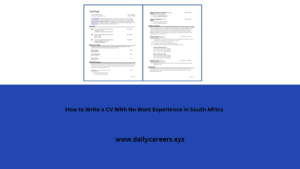
Applying for your first job can feel frustrating when vacancies ask for experience you have not yet had the chance to gain. However, you can still create a useful, professional CV by showing your education, relevant skills, projects, and responsibilities.
If you are wondering how to write a CV with no experience in South Africa, start with what you can honestly offer an employer. Your CV should help the person reading it understand your abilities, interests, and suitability for the advertised position.
This guide explains what to include, how to organise your information, and which mistakes to avoid. You will also find a simple template you can adapt.
What Is a CV?
A curriculum vitae, usually called a CV, is a document that introduces you to an employer. It summarises your education, skills, experience, and relevant achievements.
For a first-time applicant, experience does not have to mean a previous permanent job. School projects, volunteering, community activities, and informal work can provide useful examples of your abilities.
Your CV should be accurate, easy to read, and relevant to the opportunity.
1. Read the Job Advert First
Before writing your CV, read the vacancy carefully. Identify:
- The minimum education requirements.
- Skills and duties mentioned.
- The workplace location.
- Required documents.
- Application instructions and closing date.
Then identify which requirements you genuinely meet.
For example, a retail advert may mention customer service, teamwork, and basic numeracy. If you helped customers at a family business or handled payments at a school fundraiser, that could be relevant.
Use the employer’s wording where it accurately describes your abilities. Do not copy requirements into your CV if you cannot support them.
A well-written CV cannot replace a compulsory qualification or licence. Focus your efforts on opportunities for which you meet the stated requirements.
2. Add Clear Contact Details
Place your name and contact information at the top of the page.
Include:
- Your name and surname.
- A working cellphone number.
- A professional email address.
- Your suburb or town and province.
- A LinkedIn or portfolio link, if relevant and up to date.
For example:
Lerato Mokoena
Polokwane, Limpopo
Cellphone: [Your number]
Email: [Your professional email address]
An email address based on your name is usually a sensible choice. Avoid nicknames or wording that might look unprofessional.
Your town and province are generally enough for an initial CV. Avoid including your identity number, banking details, or a full residential address unless there is a specific, verified reason to provide them.
You do not need to add a photograph to a standard CV unless the application instructions specifically request one.
3. Write a Short Personal Profile
A personal profile is a brief introduction explaining your background, relevant strengths, and the kind of work you are seeking.
Keep it to around three or four lines. Avoid a long paragraph filled with claims such as “excellent at everything” or “the perfect candidate.”
Example for a Matriculant
“Recent matriculant seeking an entry-level retail position. Developed teamwork and communication skills through school activities and volunteering. Comfortable with basic calculations, following instructions, and assisting others. Available to learn workplace procedures and contribute to a team.”
Example for an Administration Applicant
“Entry-level administration applicant with experience using Microsoft Word, email, and basic Excel spreadsheets through school projects. Organised and attentive to detail, with an interest in document preparation and office support.”
Only use these examples if the details are true for you. Replace general claims with strengths you can explain in an interview.
4. Put Your Education Near the Top
When you have little or no work experience, your education should be easy to find.
Include:
- Your qualification or highest grade completed.
- The name of your school or institution.
- The year completed, or your expected completion date.
- Relevant subjects, achievements, or projects where useful.
Example
National Senior Certificate — [Year completed]
[School name], [Town]
Relevant subjects: [List subjects relevant to the vacancy]
If you are still studying, say so clearly:
Diploma in Information Technology — In progress
[Institution name]
Expected completion: [Month and year]
If you have not completed matric, state your highest grade completed accurately. Do not describe an unfinished qualification as completed.
You do not need to list every school you attended.
5. Include Skills You Can Demonstrate
A skills section should describe abilities you can actually use.
Depending on your background and the vacancy, examples may include:
- Preparing documents in Microsoft Word.
- Entering information into basic Excel spreadsheets.
- Sending emails and attaching documents.
- Communicating in relevant languages.
- Handling basic calculations.
- Organising files and keeping records.
- Assisting customers or community members.
- Working with others to complete a task.
Be specific about your level. “Basic Excel: entering data, formatting tables, and calculating totals” tells an employer more than “computer expert.”
You can list languages with an honest description of your ability, such as:
- Tshivenda: fluent.
- English: confident spoken and written communication.
- Sepedi: conversational.
Use your own languages and proficiency levels.
6. Show Experience Beyond Formal Employment
Avoid leaving your CV almost empty simply because you have never held a permanent job.
Consider whether you have:
- Helped in a family business.
- Volunteered at a community organisation.
- Tutored another learner.
- Assisted with an event.
- Completed a substantial school or college project.
- Held a leadership role.
- Done occasional paid work.
Label these activities accurately. Informal assistance should not be presented as formal employment.
Example: Informal Shop Assistance
Family Shop Assistant — Informal support
[Area] | [Dates]
- Helped customers locate products.
- Arranged stock and kept shelves tidy.
- Assisted with basic stock counts.
- Referred customer questions to the shop owner.
Example: School Project
Business Studies Group Project
[School name] | [Year]
- Worked with four classmates to develop a small-business proposal.
- Prepared a basic budget in Excel.
- Presented the group’s findings to the class.
These descriptions show what you did. Include numbers only when you can verify them.
7. Add Relevant Training and Achievements
Short courses and achievements can strengthen your CV when they relate to the position.
Examples include computer training, first-aid training, academic awards, or leadership responsibilities.
For a course, include its name, provider, and completion date. If it is still in progress, make that clear.
Do not describe an attendance certificate as a professional qualification or claim accreditation you have not verified.
Choose a few relevant achievements instead of filling the page with unrelated certificates.
8. Choose Suitable References
A reference should be someone who knows your work, learning habits, or responsibilities well enough to speak about them.
For a first-time applicant, this could be:
- A teacher or lecturer.
- A volunteer coordinator.
- A project supervisor.
- Someone who supervised your informal work.
Ask permission before sharing their contact details.
If the employer requests references, include the person’s name, role, organisation, and agreed contact details. Otherwise, you can leave references off your initial CV and prepare a separate list.
“References available on request” is optional.
9. Keep the Design Simple
For many first-time applicants, one page is enough. Use two pages if you have relevant information that needs the space.
Choose:
- A readable font.
- Clear section headings.
- Consistent dates and spacing.
- Short bullet points.
- A simple, mostly single-column layout.
Avoid large decorative graphics, skill-rating bars, and complicated tables. Important details should be written as ordinary text, making them easier for people and recruitment systems to read.
Save your CV as a text-based PDF unless the employer asks for another format. Check that you can select and copy the text from the file.
Use a clear filename:
Lerato_Mokoena_CV.pdf
CV Template for Someone With No Experience
Replace the brackets with your details and remove sections that do not apply.
[FULL NAME AND SURNAME]
[Town, Province]
Cellphone: [Your number]
Email: [Your email address]
[Optional relevant portfolio or LinkedIn link]
Personal Profile
[Your education or current status] seeking an opportunity in [type of role]. Developed [relevant skills] through [school projects, volunteering, or other activities]. Able to [specific ability relevant to the vacancy].
Education
[Qualification or highest grade completed]
[School or institution] | [Year or expected completion date]
Relevant subjects or achievements: [Optional details]
Relevant Skills
- [Specific skill and your level]
- [Specific skill and your level]
- [Relevant language and proficiency]
- [Another relevant ability]
Projects, Volunteering, or Informal Work
[Activity or role]
[Organisation or context] | [Dates]
- [What you did]
- [Responsibility you handled]
- [Outcome, if known]
Training and Achievements
[Course or achievement]
[Provider or organisation] | [Year]
References
[Include only if requested, with each person’s permission.]
Common Mistakes to Avoid
Sending the Same CV for Every Position
Keep a master CV, then adjust your profile, skills, and examples for each vacancy. A warehouse application and an administration application may need different information highlighted.
Inventing Experience
Do not create employers, qualifications, or responsibilities. Employers may check your claims or ask detailed questions in an interview.
Listing Skills Without Evidence
Replace vague claims with practical descriptions. Instead of “excellent leadership,” explain that you coordinated a group project or organised volunteers.
Leaving Incorrect Contact Details
Check every digit in your phone number and test your email address. Check your inbox and spam folder regularly after applying.
Attaching Unrequested Personal Documents
Follow the advert. Do not automatically send identity documents, bank statements, or other sensitive records to an unverified recipient.
Ignoring Application Instructions
A good CV can still be overlooked if you use the wrong email subject, omit a reference number, or submit it through the wrong channel.
Frequently Asked Questions
Can I apply for jobs without work experience?
Yes, where the advertised requirements allow it. Look for entry-level opportunities, trainee roles, learnerships, or vacancies that state experience is not required. Check each advert individually.
Should I write “no experience” on my CV?
You do not need an empty section headed “No Work Experience.” Use sections such as “Projects,” “Volunteering,” or “Relevant Activities” when you have genuine examples to include.
If an application form asks directly about employment history, answer honestly.
Can I make a CV using my phone?
Yes. A mobile document-editing app can help you create and export a CV. Before sending it, open the exported file and check the spacing, page breaks, spelling, and contact details.
Should I include my matric results?
Include results if requested or if particular subjects are relevant and strengthen your application. Send the supporting certificate or statement of results when the application instructions require it.
What if I have no volunteering or projects?
Start with your education, genuine skills, and relevant responsibilities. Keep the CV short rather than adding filler. You can build further examples through a personal project, practical training, or suitable community involvement.
Before You Send Your CV
Check that:
- Your contact details work.
- Your education and dates are accurate.
- Your skills match what you can demonstrate.
- Your examples relate to the vacancy.
- The document opens correctly.
- You have followed the application instructions.
- Someone has checked your spelling, if possible.
Your first CV does not need a long employment history. It needs to give an employer a clear, honest picture of what you have learned, what you can do, and why you are applying.